
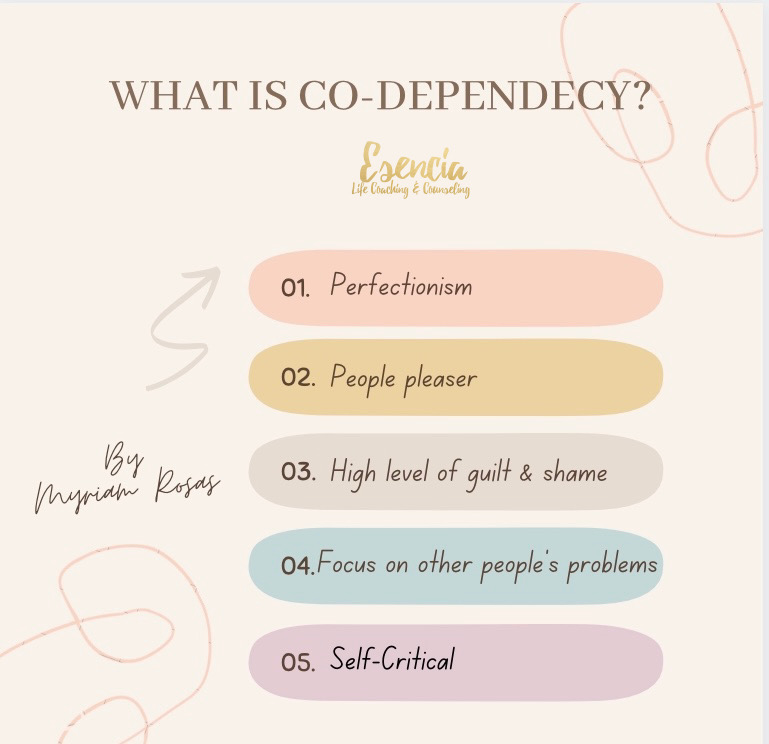
I know this information may be helpful because it helps us to recognize those co-dependent behaviors in ourselves.
What is Co-Dependency?
Co-dependency incorporates aspects of existing style patterns that are developed in early childhood. This behavior could be learned from parents. Yes, from the parents, as a learning behavior, so it is normal to act or react like that.
Co-dependency is due to the “poor concept of ourselves” and also having poor boundaries; this includes the inability to have an opinion or just to say “no.”
I’m sharing some of the many co-dependencies that exist in a human being.
This information only has the intention to inform and educate, if you relate to any of these behaviors, I suggest consulting and seek for professional help. You are not alone. The first step is to recognize that behavior towards ourselves.
Some of the characteristics are:
- Perfectionism: everything has to be absolutely perfect, otherwise they suffer and get frustrated and mad easily. Perfectionists often equate mistakes with failure. They can not make mistakes. They do not allow themselves to make mistakes and for this reason, they tend to stress more often. They are high achievers, however, they tend to spot mistakes and imperfections quickly.
- People pleaser: they feel the responsibility to make other people happy even if they have to neglect themselves. They have difficulty saying “no” They are concerned with what other people think about them and say about them. They usually struggle with low-self esteem.
- High level of guilt & shame: toxic and negative self-evaluations like “I do everything wrong” or “I can’t do anything right.” The guilt feeling refers to making a mistake, they are afraid to do things because of the guilt they carry, in addition, they believe bad things happen to them because they deserve it; the shame feeling is about “not feeling worth it and to consider themselves as a bad person.”
- Focus on other people’s problems: fixing, advising, and caretaking other people’s problems when they negatively deny their own needs and impact negatively their overall health. These people offer their help even when it is not required. They like to resolve people’s problems to feel worthy and valuable. Also, it is a good manner to distract themselves of their own problems.
- Self-Critical: the negative and destructive response of themselves in a very toxic way. They bully themselves by self-talking. For example, ” I am so ugly” or “no one is going to love me” This negative self-taking brings one of the highest levels of anxiety.
There is always hope in the process.
“Keep on asking, and you will be given what you ask for. Keep on looking, and you will find. Keep on knocking, and the door will be opened… Your heavenly Father [will] give good gifts to those who ask him”
(Matthew 7:7,  NLT).
Did you relate to any of these characteristics? Would you like to have information and learn more about co-dependency?
Don’t forget to share this post!

 Esencia